
By Craig Allen
•
January 3, 2026
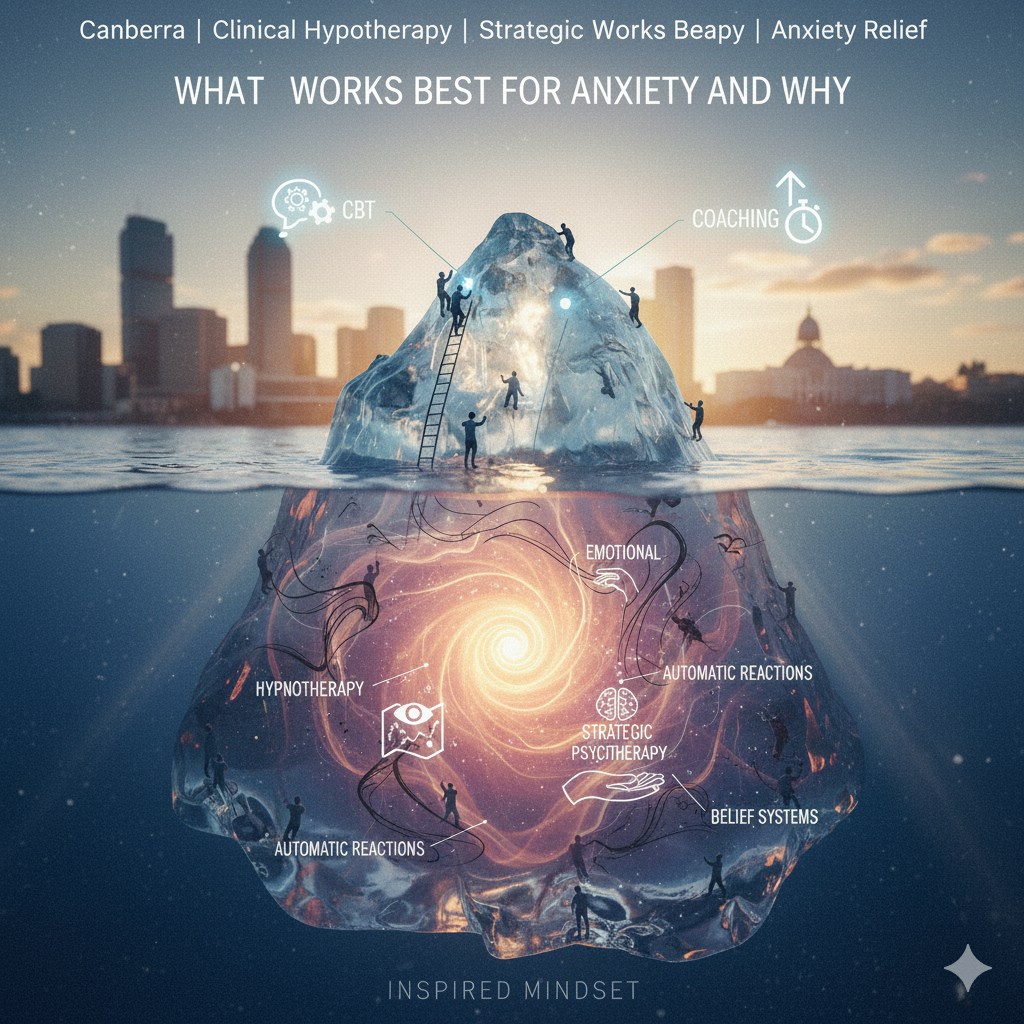
By Craig Allen – Clinical Hypnotherapist & Strategic Psychotherapist, Canberra Summary This article explains how clinical hypnotherapy and strategic psychotherapy use neuroplasticity to interrupt anxiety and addiction patterns, based on lived experience and real clinical practice at Inspired Mindset in Canberra. Introduction: Why Insight Alone Often Isn’t Enough I don’t teach neuroplasticity because I read it in a textbook. I teach it because I lived it. Years ago, I was stuck in a repeating loop of addiction. I tried willpower. I tried logic. I tried traditional talk therapy. I understood why I was doing what I was doing — but nothing actually changed. What finally worked was learning how the brain forms highly efficient automatic patterns, and how those patterns can be updated rather than fought. Through Strategic Psychotherapy and Clinical Hypnosis, I learned how to dismantle the old “addiction highway” my brain had built and replace it with a different operating system altogether. Today, at Inspired Mindset Hypnotherapy Canberra, I use that same understanding to help clients realise something critical: You are not broken. You have a very efficient brain running an unhelpful strategy. Once the strategy changes, the struggle often reduces dramatically. What This Article Explains This article is for people who: Understand why they struggle with anxiety or addiction Have insight but still feel controlled by automatic reactions Feel “stuck” despite intelligence, motivation, or previous therapy It explains how neuroplasticity-based approaches, such as hypnotherapy and strategic psychotherapy, work at the level of subconscious patterns — not willpower alone — and why this matters in real clinical practice. What is Neuroplasticity-Based Hypnotherapy? Definition: Neuroplasticity-based hypnotherapy is a clinical approach that uses the brain's natural ability to form new neural pathways to interrupt automatic anxiety and addiction loops. Unlike talk therapy, which engages the logical mind, this method targets the subconscious "pattern" to update the nervous system's response. Neuroplasticity: The Inspired Mindset Roadmap Your brain is plastic. That means it can change at any age — not through force, but through targeted learning. Research consistently supports the brain's ability to reorganize itself by forming new neural connections throughout life, a principle that is fundamental to modern clinical hypnotherapy. At Inspired Mindset, our integrated approach follows a simple, clinically grounded three-step roadmap. 1. Pattern Identification – The Strategy Using Strategic Psychotherapy, we map how the problem runs. This includes: Cognitive distortions Emotional triggers Situational patterns The exact moment the “hijack” occurs This step answers the question: “What is the pattern, and how does it keep repeating?” Dive Deeper: If you are unsure which therapy fits your needs, read our detailed comparison: Hypnotherapy vs CBT vs Coaching: What Works Best for Anxiety? 2. Pattern Interruption – The Hypnosis Hypnosis works by reducing the interference of the part of the mind that says: “This won’t work” “I’ve always been like this” “I should be over this by now” In a focused hypnotic state, the brain becomes more receptive to updating learned emotional responses. This allows us to: Interrupt automatic anxiety or craving loops Reduce physiological over-reaction Create new emotional associations This is not loss of control. It is access to a learning state the brain already uses naturally. Further Reading: Curious about the science? We break it down in Does Hypnotherapy Really Work? Here’s What to Know . 3. Future-Proofing – The Coaching Once the old loop is weakened, we build forward momentum. Through Mindset Coaching, we: Reinforce new habits Strengthen identity shifts Prevent relapse into old patterns Build confidence through action This ensures the change isn’t just a temporary feeling — but a durable behavioural shift. Who Is Strategic Psychotherapy and Hypnotherapy For? This is not relaxation or surface-level mindset work. In my Canberra CBD clinical practice, this approach is particularly effective for: Panic and phobias – where the body reacts before thought Addictive behaviours – where cravings feel automatic and overpowering. (See also: Hypnotherapy for Addiction or our guide on Hypnosis for Gambling High-functioning anxiety – overthinking, control, and nervous-system overload Executive burnout – chronic amygdala activation under sustained pressure Related Guide: Learn more about our specific approach to Hypnotherapy for Anxiety & Depression . Does Hypnotherapy Work When Talk Therapy Hasn’t? Often, yes — particularly when insight is already present. Many clients understand their anxiety or addiction intellectually, yet still experience strong physical responses. In these cases, hypnotherapy can help by addressing the conditioned nervous-system reaction, not just conscious thought. This is why people often seek hypnotherapy after traditional approaches plateau. Who This Approach May Not Be Suitable For This work is not a replacement for: Acute psychiatric care Emergency mental health intervention Medical treatment Individuals experiencing active psychosis, unmanaged bipolar disorder, or immediate safety risks should seek appropriate medical or crisis services. Real Experience, Not Just Theory “I don’t just teach these methods; I used these exact tools to overcome my own addiction. This isn’t theory — it’s a roadmap I’ve lived.” — Craig Allen, Clinical Hypnotherapist “I tried traditional psychology for years. It helped me understand my anxiety, but the physical response didn’t change. After several hypnotherapy sessions with Craig, the anxiety response finally settled.” — Canberra Client Conclusion: You Don’t Have to Fight Your Brain Willpower is an exhaustible resource. Your subconscious is not the enemy — it’s an engine. When that engine is running the wrong program, life feels like a constant battle. When the program changes, effort drops away. If you’re ready to move past understanding why and start changing how, this work may be a good fit. Frequently Asked Questions (FAQ) Can hypnotherapy really change my brain? Yes. Through neuroplasticity, hypnotherapy helps "prune" old neural pathways (anxiety loops) and strengthen new ones (calm responses), effectively updating the brain's automatic software. Is this different from standard meditation? Yes. While meditation focuses on observation and mindfulness, Strategic Psychotherapy and Hypnotherapy are active interventions designed to dismantle specific triggers and install new behavioral patterns. How many sessions are typically needed? Unlike long-term talk therapy, this approach is brief and solution-focused. While every client is different, many people experience significant shifts within 3 to 6 sessions. Ready to Take the Next Step? If you’re in Canberra or looking for online hypnotherapy, you can book a free, no-pressure discovery call to discuss whether this approach is right for you. 👉 Book a Free 15-Minute Discovery Call with Craig Allen 👉 Explore Anxiety & Addiction Treatment Packages About the Author Craig Allen is a Certified Clinical Hypnotherapist and Strategic Psychotherapist based in Canberra. His work integrates clinical training with lived experience to help clients break free from anxiety, addiction, and entrenched behavioural patterns. At Inspired Mindset, Craig combines clinical hypnotherapy, strategic psychotherapy, and evidence-based coaching to support lasting change — not just symptom management.